Plug In, Scoot Over: Local Multiplayer Is Back and It Never Should Have Left
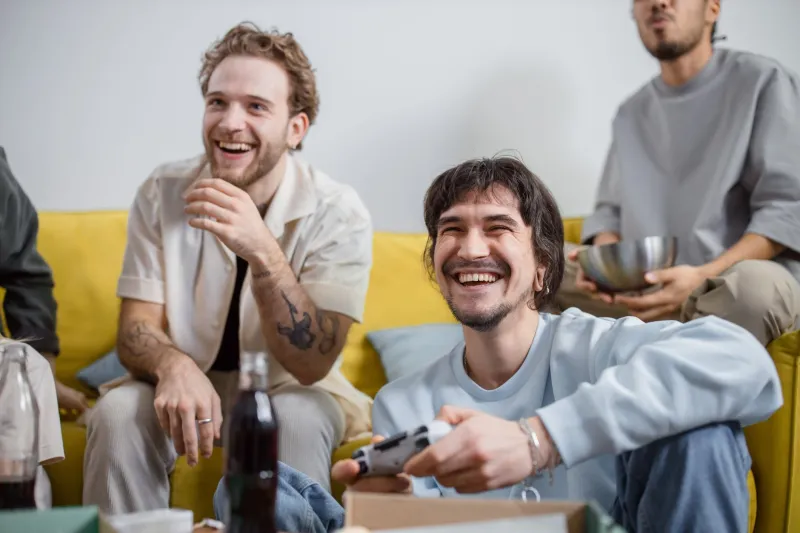
There's a specific kind of chaos that only happens when four people are crammed onto a couch, controllers tangled, someone's elbow in someone else's ribs, and the whole room is screaming because Player 3 just betrayed everyone for the third time in a row. You can't get that from a headset. You can't get that from a Discord call. That chaos — that beautiful, slightly sweaty chaos — is couch co-op, and after years of being pushed to the sidelines by online multiplayer, it's staging one of gaming's most satisfying comebacks.
And here's the thing: indie developers saw it coming before anyone else did.
How Online Took Over (And What Got Lost)
Cast your mind back to the late 90s and early 2000s. Nintendo 64 four-player ports. GoldenEye 007 on a screen so small you could barely see your character. Tony Hawk's Pro Skater passing the controller back and forth like a relay baton. Local multiplayer wasn't a feature back then — it was basically the feature.
Then broadband internet got cheap and fast, Xbox Live launched, and suddenly the promise of playing against anyone, anywhere, anytime made same-room gaming feel almost quaint. Why deal with split-screen when you could have your own full-resolution view? Why coordinate schedules with friends when strangers online were always available?
The answer, it turns out, is everything that made gaming social in the first place.
"There's a reason people still talk about those old GoldenEye sessions like they were the best nights of their lives," says Marcus Webb, a solo indie developer based out of Austin, Texas, who's currently building a couch co-op party game. "Nobody's sitting around getting nostalgic about beating someone in a random online lobby. But they remember exactly who was in the room when something wild happened."
Indie Devs Are Betting the Farm on Your Living Room
While major studios spent the 2010s doubling down on battle royales and live-service online ecosystems, a quieter movement was building in the indie space. Games like Overcooked, Lovers in a Dangerous Spacetime, It Takes Two, and Cuphead weren't just critically acclaimed — they became genuine cultural moments, the kind of games people bought specifically because they had someone to play with right now, in the same room.
It Takes Two won Game of the Year at The Game Awards in 2021. A couch co-op game. Let that sink in.
Developers noticed. Indie studios especially, who've always been more nimble and willing to chase what players actually want rather than what spreadsheets suggest they should want, started leaning hard into local multiplayer mechanics.
Sophia Tran, co-founder of a small studio in Seattle, explains the appeal from a development standpoint: "When you design for couch co-op, you're designing for a shared emotional experience. The players can see each other's faces. They react to each other in real time. That feedback loop is incredibly powerful, and honestly, it pushes you to make moments that are genuinely surprising and funny, not just mechanically satisfying."
That design philosophy shows. The best modern couch co-op games feel engineered for stories — the kind you retell at work on Monday morning.
The Friendship Factor Nobody's Talking About
Beyond nostalgia and game design theory, there's something more grounded driving this resurgence: people are craving real-world connection in ways the pandemic years made impossible to ignore.
Jamila and Derek, a couple from Chicago, started buying couch co-op games during the lockdowns as a way to break up the monotony of being home together constantly. "We'd played online games separately before, but never really together," Jamila says. "Then we started playing Stardew Valley on the couch and it became this whole thing — our Friday night ritual. We've played probably fifteen games that way now. It's genuinely one of the best things that came out of that whole terrible period."
That sentiment echoes across gaming communities. Local multiplayer has become a vehicle for rekindling friendships, strengthening relationships, and yes, occasionally destroying them — at least temporarily — over a particularly savage round of Pummel Party.
Family gaming is another huge driver. Parents who grew up gaming in the 90s are now raising kids old enough to hold a controller, and couch co-op is the natural bridge. It doesn't require separate subscriptions, separate devices, or a stable internet connection. It just requires a TV, a couch, and a willingness to lose gracefully.
The Best Modern Couch Co-op Experiences Right Now
If you're ready to rediscover what your living room was always meant to be, here's where to start:
It Takes Two — Still the gold standard. A platformer-meets-puzzle game built entirely around two-player co-op, with mechanics that change every hour. Genuinely one of the best games made in the last decade, full stop.
Overcooked! 2 — Do you think your friendship is solid? This game will test that theory. Frantic, hilarious kitchen chaos that somehow gets more fun the worse you do.
Cuphead — Brutally hard, jaw-droppingly gorgeous, and infinitely better with a friend to share the suffering. A hand-drawn love letter to 1930s animation that'll make you feel things.
Lovers in a Dangerous Spacetime — A cooperative space shooter that's as charming as it sounds. Great entry point for playing with someone who doesn't game much.
Unravel Two — Quiet, beautiful, and surprisingly emotional. Two players control yarn characters tethered together, and the whole thing feels like a metaphor for every good relationship you've ever had.
Moving Out — Physics-based moving simulator that is absolutely unhinged in the best way. One of the funniest games you can play with another human being in the same room.
Where This Goes Next
The momentum isn't slowing down. Indie studios are actively pitching couch co-op as a selling point in their marketing, not an afterthought. Gaming events like PAX and local game nights at bars and community spaces are seeing strong turnout built around local multiplayer setups. Even hardware manufacturers are paying attention — the Nintendo Switch's entire design philosophy is essentially a love letter to playing games with people near you.
What started as nostalgia has become something more deliberate. Players aren't just tolerating local multiplayer — they're seeking it out, requesting it, and building communities around it.
The online era gave us scale. It gave us persistence, leaderboards, and the ability to play with anyone on the planet. Those things are genuinely great. But they never quite replaced what you get when someone is literally sitting next to you, losing their mind over the same moment you're losing your mind over.
Some experiences are just better when they're shared in real time, in real space, with real people who will absolutely never let you forget what happened in that final round.
Plug in a second controller. Scoot over. Your living room is a gaming venue again.