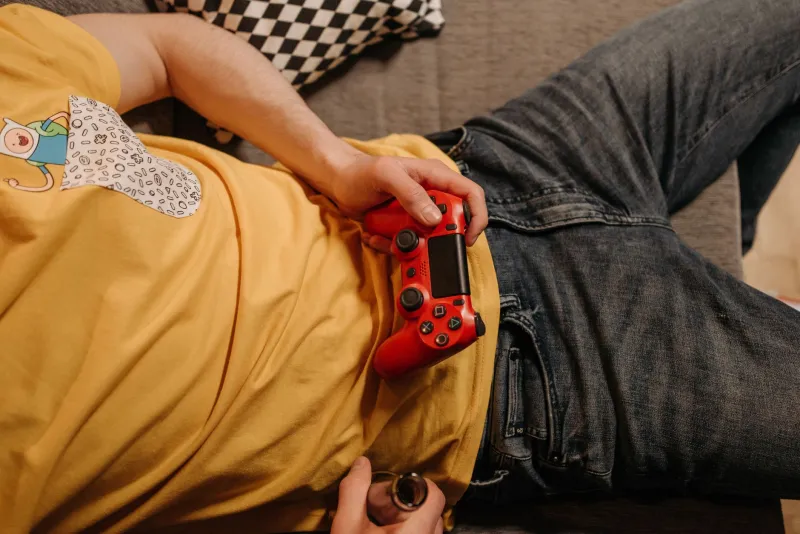
Same Couch, Same Screen, No Wi-Fi Needed: The Local Multiplayer Comeback That's Bringing Gamers Back Together
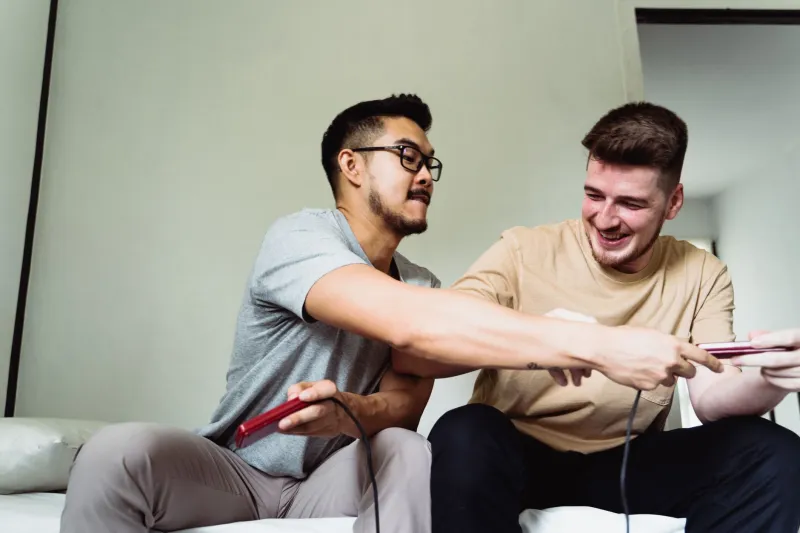
There's a specific kind of chaos that only happens when two people are sharing one controller — or one screen, or one very cramped couch cushion. Someone shouts. Someone laughs so hard they lose focus entirely. Someone absolutely did not mean to knock the other player off that ledge, and nobody believes them.
That moment? You can't manufacture it online. You can't replicate it through a headset. And a growing wave of indie developers, psychologists, and hardcore gaming fans are arguing that chasing that moment back is one of the most worthwhile things the gaming world can do right now.
Local multiplayer — the kind where everyone's in the same room, staring at the same TV — is making a comeback. And it's not riding on nostalgia alone.
The Loneliness Problem Nobody's Talking About
Online gaming is massive. Billions of people play. The infrastructure is incredible. But somewhere between ranked matchmaking, anonymous lobbies, and the endless grind of competitive modes, something got lost.
"There's a difference between playing with someone and playing at someone," says Marcus Delray, an indie developer based in Austin whose studio, Patchwork Play, released a local co-op puzzle game last year that sold out its physical edition twice. "Online competitive gaming is incredible for a lot of things, but it's optimized for performance. Local play is optimized for the relationship."
That distinction matters more than it sounds. Research in social psychology consistently shows that physical proximity amplifies shared emotional experiences. When you're sitting next to someone and something funny, scary, or genuinely surprising happens in a game, you both react in real time — and those synchronized reactions build what researchers call "social bonding cues." You're not just playing together. You're experiencing together.
Dr. Priya Nambiar, a cognitive neuroscientist at a university in the Pacific Northwest who studies how social play affects the brain, puts it plainly: "Shared physical space creates what we call mirrored emotional responses. When two people laugh at the same moment, or gasp together, the brain registers that as a deeply connective event. Online, you lose almost all of that. You're isolated in your own physical environment, even if you're technically playing together."
Indie Devs Are Designing for the Room, Not the Lobby
The really interesting part of this story isn't that people miss couch co-op. It's that a specific corner of the indie development world is actively building for it — on purpose, as a creative and philosophical choice.
Studios like Patchwork Play, along with a handful of others scattered across cities like Portland, Chicago, and Nashville, are designing games that only make full sense when played in person. Shared screens. Split mechanics. Puzzles that require two people to literally communicate out loud to solve. Some games are even introducing asymmetric information — where each player sees something different on the screen and has to describe it to the other without looking.
"We wanted the game to create conversation," says Delray. "Not just cooperation, but actual talking. Laughing. Arguing. That's the design goal."
It's a counter-cultural stance in an industry that has spent two decades perfecting online infrastructure. But it's resonating. Games like Overcooked, It Takes Two, Moving Out, and Lovers in a Dangerous Spacetime have all found passionate audiences by committing to the local experience — and several have gone on to sell millions of copies without ever needing a ranked ladder or a battle pass.
It Takes Two won Game of the Year in 2021. It doesn't have an online multiplayer mode at all.
The Social Layer That Wi-Fi Can't Provide
Ask anyone who's played a great local co-op game recently what they remember most, and they almost never describe a specific mechanic or level. They describe a moment with another person.
Amanda Cho, a 28-year-old teacher from Columbus, Ohio, remembers the exact night she and her roommate played through a local co-op game until 2 a.m. on a Tuesday. "We were both so bad at it," she laughs. "But we were bad at it together, in the same room, and it was honestly one of the best nights of my whole year. I don't think that happens over voice chat. There's something about being physically there."
That "something" has a name in psychology — it's called "co-presence," and it's one of the strongest predictors of social bonding. The body language, the shared glances, the instinctive reactions you have when something goes sideways in a game — all of it feeds a kind of connection that remote play just can't fully replicate.
For a generation that grew up hearing about how gaming is isolating, there's something quietly powerful about the idea that the right kind of game, played the right way, might actually be one of the most socially rich experiences available to us.
The Hardware Is Catching Up Again
For a while, local multiplayer fell off partly because the hardware made it awkward. Not every TV was big enough. Not every console came with two controllers in the box. Online play was convenient in a way that dragging a friend over and setting up split-screen wasn't.
But things have shifted. Big-screen TVs are cheaper than ever. The Nintendo Switch made pass-the-controller gaming socially cool again at a scale nobody expected. And indie developers — who don't have to answer to shareholders demanding engagement metrics — have leaned into local play precisely because it sidesteps the expensive, complex infrastructure of online multiplayer.
"We couldn't afford to build out online servers," admits Delray, with a grin. "So we built something you can only play in the same room. And honestly, that constraint made the game better."
A Million Ways to Play — And Sometimes the Best One Is Right Next to You
Here's the thing about gaming in 2025: there are genuinely a million ways to do it. You can grind ranked modes at midnight, solo. You can stream to a crowd of thousands. You can blast through a narrative experience in a single sitting. All of it is valid. All of it is real gaming.
But there's a specific kind of play that doesn't require a subscription, a stable connection, or a headset. It just requires another person willing to sit down next to you and share something.
The indie studios building for that experience aren't trying to replace online gaming. They're filling a gap that online gaming — for all its scale and sophistication — quietly left behind. And judging by the audiences showing up for these games, a whole lot of players have been waiting for someone to fill it.
So clear some space on the couch. Grab a second controller. And maybe, just for one night, put the Wi-Fi on do-not-disturb.
Some of the best gaming moments you'll ever have don't need a signal.